


For years, treatment decisions relied on tumor location, stage, and appearance. But cancers that look similar under a microscope can behave very differently at the molecular level.
 Unpredictable responses Unnecessary toxicity Missed targeted therapy opportunities
Comprehensive Genomic Profiling (CGP) analyzes hundreds of cancer-related genes using next-generation sequencing.
Somatic mutations Tumor mutational burden Copy-number gains/losses MSI-H & mismatch repair deficiency Gene fusions (e.g., ALK, ROS1, NTRK)Each alteration tells clinicians how the tumor is likely to respond — or resist — specific therapies.
Examples: EGFR, BRAF, KRAS
G12C, HER2, RET.
These mutations can be
matched to FDA-approved
targeted therapies.
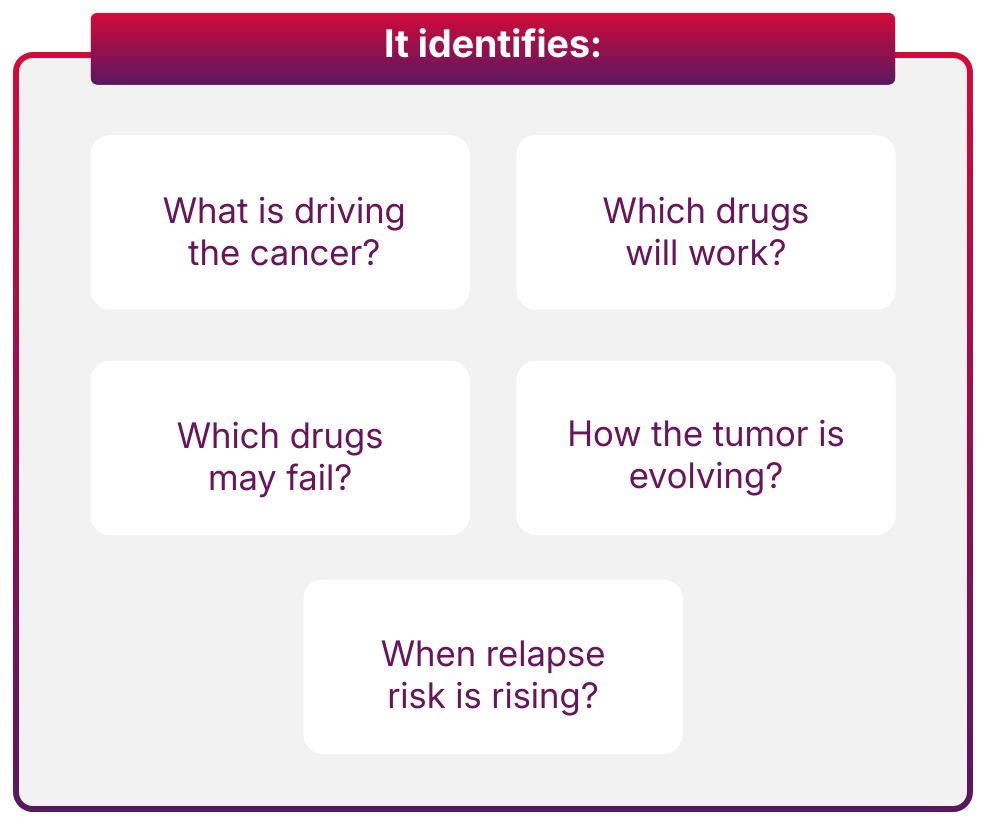
Profiling uncovers why treatment stopped working, e.g., EGFR T790M, ALK G1202R, ESR1 mutations — helping clinicians choose the next best line of therapy.
Biomarkers like MSI-H, TMBhigh, and MMR deficiency indicate likelihood of response.
Certain biomarkers allow therapies that work across cancer types — regardless of tumor origin.
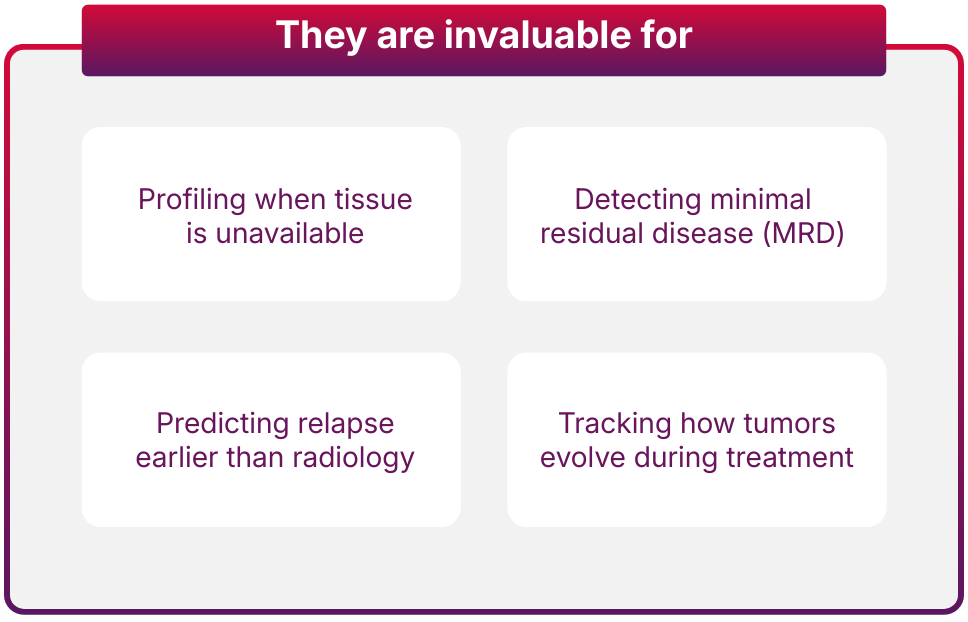
ctDNA-based assays provide a non-invasive way to understand tumor biology through circulating tumor DNA.
Showed feasibility of matching therapies based on genomic alterations across tumor types. TAPUR
Demonstrated improved progression-free survival with matched therapy vs prior lines.
Real-world evidence showing benefit of targeted drugs beyond labeled indications.
Large datasets linking genomic alterations to clinical outcomes..
Different labs produce slightly different results.
Testing access is still uneven across regions.
Many alterations lack sufficient clinical data.
Rapidly progressing cancers need fast results (<14 days).
Not all patients get access to advanced testing.

The next evolution of cancer care integrates multiple data types:
DNA + RNA sequencing for deeper variant interpretation Proteomics to understand pathway activation AI models to classify variants and recommend therapies MRD-guided treatment to personalize adjuvant therapy Standardized global protocols to reduce variation across labs
This transforms the entire patient journey from diagnosis to long-term monitoring.
Genomic profiling is no longer optional — it is essential for delivering the most effective, evidence-based, and personalized treatment plans. As technology advances and access expands, precision oncology will become the global standard of cancer care.

 +91 93459 07119
 info@iaioncology.org
 Visit Our Website
 www.iaioncology.org